Driving in Tenerife
Driving in Tenerife: the two motorways, the mountain roads, the parking colours, the beacon that replaced warning triangles, and what to check in a hire car.
Tenerife is an easy island to drive and a hard one to judge distances on. It is a little over eighty kilometres long, which sounds like nothing, and it has a three-thousand-metre volcano in the middle of it, which is the part that decides every journey time. The coast roads are quick. Anything that crosses the island is not.
A week here is spent on two motorways and the smaller roads that leave them. This is what those are actually like, what the rules are, and which of them have changed recently enough that older advice is now wrong.
The two motorways, and what they cost
The TF-1 runs from Santa Cruz down the east coast, past the terminal at Tenerife South, and along the south to Adeje. The TF-5 runs from Santa Cruz along the north to Icod de los Vinos. Between them they carry almost everything, and both are dual carriageway for their whole length.
They cost nothing. Tenerife has no toll roads at all, which surprises drivers used to mainland Spain or to France, and it means the charges the rental puts on you here are fuel, parking and fines. Fuel is the other pleasant surprise: the Canaries sit outside the mainland fuel duty regime and apply their own tax instead, so a tank here is noticeably cheaper than on the peninsula and considerably cheaper than in the United Kingdom.
Fines are the part to take seriously. There are fixed speed cameras on both the TF-1 and the TF-5, including an average-speed pair, and paying a fine is the renter's responsibility. Speed limits are posted, so read the signs rather than assuming a limit, and the enforcement is real rather than decorative.
The one thing no table on this site can show you is the traffic, because every time here is a free-flow figure from routing that does not model it. The climb out of Costa Adeje onto the TF-1 starts a drive to the airport that is thirty minutes on paper, so on a flight day put the route into a live map before you set off and allow whatever it adds.
What has to be in the car by law?
A connected V-16 beacon, and this is the change that makes older advice wrong. Since the first of January 2026 the beacon has replaced warning triangles on Spanish-registered vehicles: it is a small orange light that sits on the roof and reports its position to the traffic authority, so a driver signals a breakdown without walking along a hard shoulder to place a triangle. Every hire car on this island is Spanish-registered, so it applies to you rather than to somebody else, and rental fleets supply one with the car.
Not carrying one, or carrying an unapproved one, is an eighty euro fine on the driver. Check it is actually in the car at handover, in the same ten minutes you spend photographing the wheels, and do that whether the car is brought to your hotel or you are hiring a car at the south terminal and walking out to it. Whether a particular supplier has included one is a per-car matter, so look rather than assume.
The rest is the usual: licence, rental documents, and a phone that will take a call in Spain, which is a rental condition rather than a courtesy. Children of 135 centimetres and under need an approved restraint suited to their size and, as a general rule, travel in the rear seats, with the front allowed only by exception. It is a height rule rather than an age rule, and an unsecured child is two hundred euros and three points.
If a dog is coming, two rules apply at once. The rental permits small pets only, in their carriers throughout, and Spanish traffic law separately requires any animal to be restrained so the driver keeps full freedom of movement, visibility and attention. Loose in the back is eighty to two hundred euros; in the front passenger seat it can reach five hundred, and that is true even inside a carrier, because the carrier is then in the wrong place.
What do the coloured parking lines mean?
Blue lines are metered bays with a time limit. A blue bay is paid for at a machine and the ticket goes on the dashboard, and the time limit is the part people forget. Unmarked white bays are free and are the ones to look for. Yellow means no parking at all, and in a resort built on a slope the yellow is usually there because something large needs the room.
That is the whole system. It is national rather than local, and it is worth ten seconds because a resort parking fine is an easy and entirely avoidable way to lose money. In the towns, the covered car parks are the sane option for a day out. Check the car park's height limit against the car's full height before driving in.
Santa Cruz is the one place where the answer is a multi-storey rather than a street, because the multi-storey under the transport interchange is the obvious answer for the centre. In the resorts, park a few streets uphill and walk down; the walk back is the only cost and it is a shorter one than a circuit of the seafront in August.
The climb to Teide, and how cold it really is
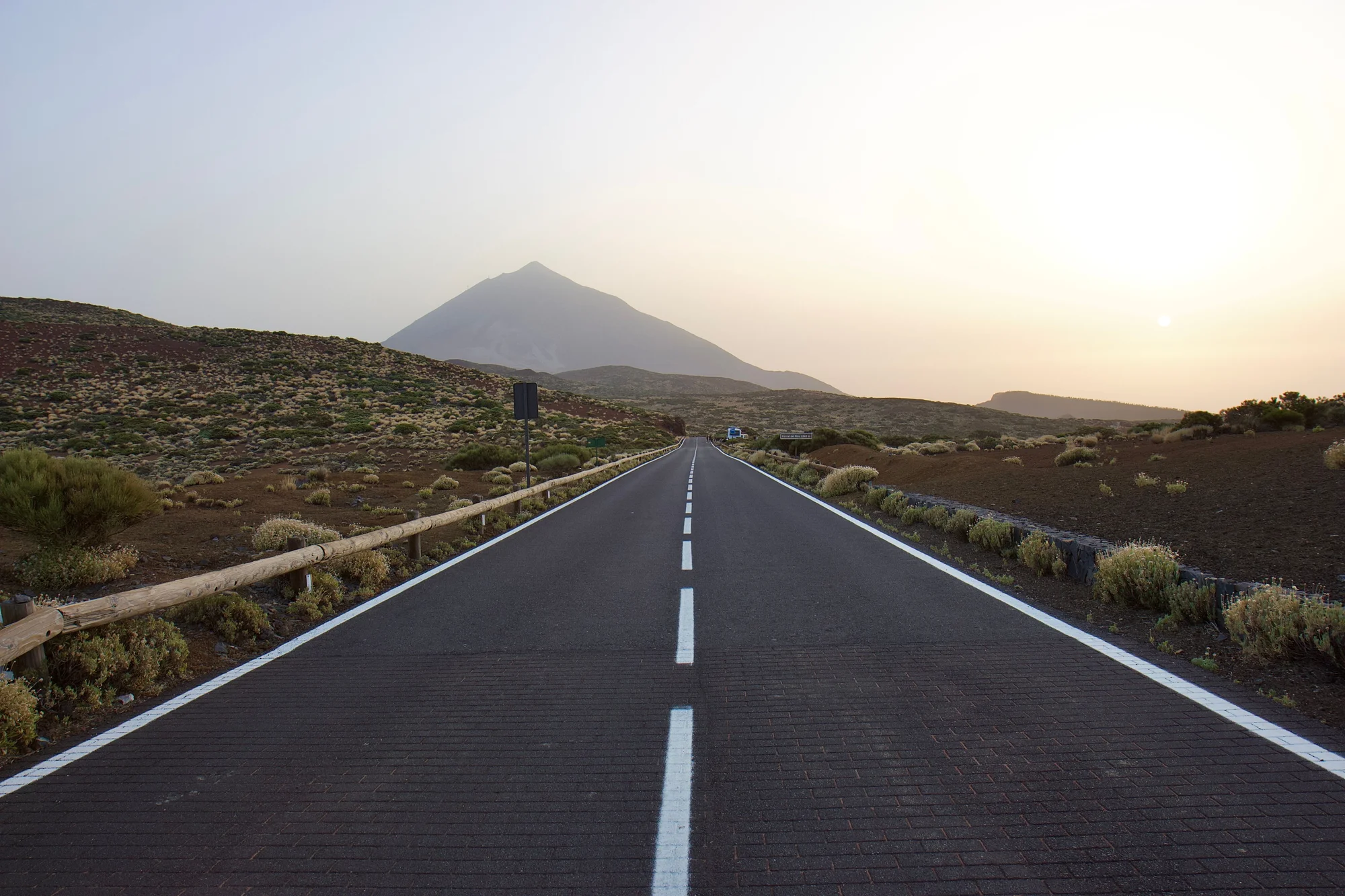
The southern approach is the TF-21 through Vilaflor, and it is the approach that starts nearest the airport and the resorts. It climbs from sea level into the crater in an hour, through banana terraces, then pine forest, then a landscape with nothing in it at all. Vilaflor at roughly 1,400 metres is the highest municipality in the Canary Islands, which is worth saying accurately: it is not the highest in Spain, and two mainland villages are higher.
Take a coat rather than a jumper. The crater floor runs about eleven degrees below the coast on an annual average and roughly fourteen degrees below it in January, so a January morning that is eighteen on the beach is single figures at the Parador. In August the gap is smaller, five or six degrees, which catches people out the other way. The twenty-degree figure that circulates is roughly right only at the cable car top station at 3,555 metres, which is a different place and above the cloud inversion.
There is no fuel anywhere inside the national park, so fill up before you start. The cable car base sits at kilometre 43 of the TF-21 at 2,356 metres, tickets are sold online in advance, and it closes in adverse wind with no published threshold, so it is worth checking before committing the day to it. The final walk to the summit needs a timed permit booked through the island authority's platform, and since September 2025 it is no longer free for non-residents.
Coming down in the dark is slower than the map says. If you are going up for sunset, plan the descent as its own leg rather than as an afterthought, and do not count on street lighting.
Your dates. Your starting point.
Compare the cars available for your trip, then check the payment card and deposit requirements for the one you choose.
Find a carFree-flow driving times from Tenerife South Airport.
Can I drive the Masca road?
Sometimes. Whether you can depends on an access control that is switched on and off, not on a fixed rule. Since the end of July 2026 the island authority has run access control on the TF-436, the only road in and out of Masca, between nine in the morning and four in the afternoon, with control points at Las Lagunetas and at Santiago del Teide and an information point at Los Pedregales. Vehicles driven by visitors for purely recreational purposes are turned away. Residents, property owners, people travelling for work, small public transport and emergency services pass.
The stated reason is wildfire risk and emergency access: the road's narrow sections make it hard for a fire appliance to pass oncoming traffic, and there is no alternative route. It is explicitly temporary and dynamic, switched on and off with the risk level and with no end date announced, so the only reliable answer is the one you get on the morning itself. Check before you set off. The 355 bus is the alternative the authority is pushing and it has got noticeably busier since the controls began.
Even when the road is open there is a second rule worth knowing. Since May 2025 tour coaches in Teno are limited to ten metres and run one way, entering Masca from Buenavista and leaving toward Santiago del Teide. So driving the TF-436 southward you travel with the coach flow, and driving it northward you meet them, on a road with very little room to be generous. From the west coast it is a short run, twenty-four minutes from Los Gigantes.
The north is a different island
The trade winds bank cloud against the north side, so a morning that is bright and hot in the south can be grey, wet and cooler over the ridge at the same hour. The run along the north coast to Puerto de la Cruz is where you notice it: the road can be wet on that side while the south is dry, so if the road is wet, adjust your driving to the conditions. It is not difficult driving, but it is not the TF-1 either.
Two tunnels deserve a mention because both are unlit. The Martianez false tunnel on the TF-31 at Puerto de la Cruz is just under three hundred metres. El Bailadero on the TF-134 in Anaga is three hundred and seventy-five. In each case the answer is to slow before you enter rather than inside, when your eyes have not yet adjusted.
Anaga itself, behind Santa Cruz, is a long run of hairpins through laurel forest with the sea appearing and disappearing below. It is also the place where the paved-roads-only condition matters, because the tracks that branch off look inviting and are not permitted. That restriction is not about road quality, it is a term of the rental, and the two overlap almost exactly, because the Tenerife car hire insurance that comes as standard leaves out the wheels and the undercarriage, which is what a track damages.
Three practical habits worth having
Fill up when you pass a station rather than when you need one. The motorway corridor is well served, but there is no fuel in the national park, none in Los Gigantes or Puerto de Santiago, and none in Golf del Sur or Los Abrigos; the nearest cluster to that last group is at Las Chafiras, about three kilometres away.
Photograph the car at handover, concentrating on the wheels, the underside, the windscreen and the fuel gauge. Those are the four things that turn into an argument later, and the first three are precisely what the standard cover excludes.
And decide early whether the car ends where it started. One-way car hire in Tenerife is what makes a two-coast trip work without driving the crossing twice, and the list of places a car can be handed over is almost the same list at both ends of it.
If you are still weighing whether to have a car at all, the question underneath it is whether you want the island or the resort. A week without a car is a week on the bus timetable and the resort's own doorstep, which is a perfectly good holiday and a completely different one.
Useful answers
These come up on the road rather than at the booking stage, so they are worth reading before you set off.
Are there toll roads in Tenerife?
No, none. Fuel, parking and fines are what the rental puts on you, and fuel here is cheaper than on the Spanish mainland because the Canaries apply their own tax regime.
Do I still need a warning triangle?
No. A connected V-16 beacon replaced triangles on Spanish-registered vehicles on 1 January 2026, and every hire car here is Spanish-registered. Not carrying an approved one is an eighty euro fine.
How much colder is the Teide crater?
About eleven degrees below the coast on an annual average and roughly fourteen in January. The twenty degrees people quote applies at the cable car top station, which is well above the crater floor.
Is the road to Masca open?
It depends on the day. Access control runs from nine to four while a fire-risk alert stands and turns back visitors driving for leisure. It switches on and off, so check rather than trusting any page's date.
Can I drive on the dirt tracks?
No. Hire cars are permitted on paved public roads only. The tracks are also where the wheels and the undercarriage get damaged, and both are excluded from the standard cover.
Where can I not find fuel?
Inside the national park, in Los Gigantes and Puerto de Santiago, and in Golf del Sur and Los Abrigos. The nearest station to that last group is at Las Chafiras.
Is it worth driving to the north for a day?
Yes, and it is a full day rather than an afternoon: Puerto de la Cruz is eighty-one minutes from the airport. Expect cloud, cooler air and slower roads than the south.